Service Manual (KLZ1000C) — page 368 of 762
Brakes › Brake Line Bleeding
Text on this page
12-28 BRAKES
Brake Fluid

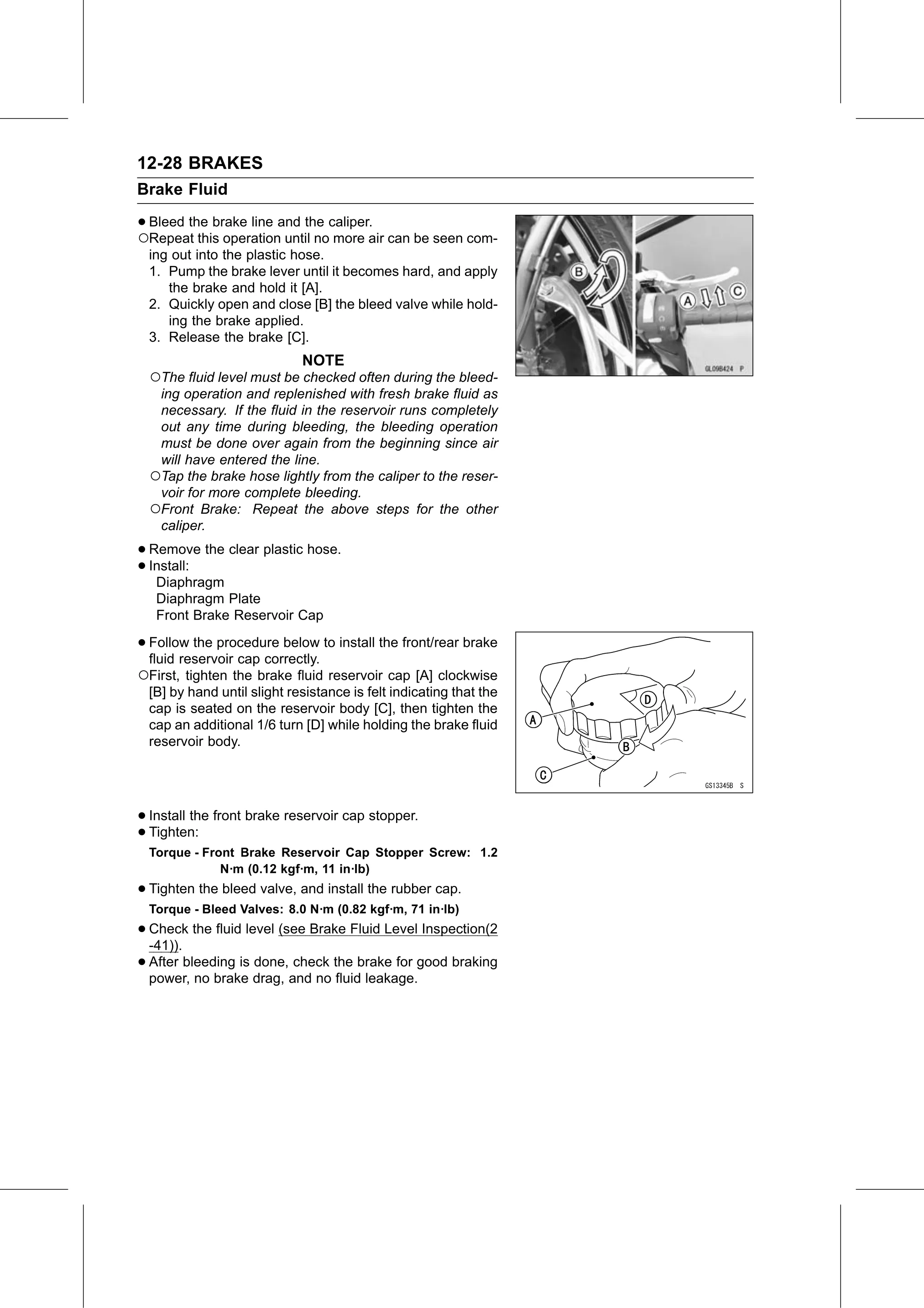
•○Bleed the brake line and the caliper.
  Repeat this operation until no more air can be seen com-
  ing out into the plastic hose.
  1. Pump the brake lever until it becomes hard, and apply
     the brake and hold it [A].
  2. Quickly open and close [B] the bleed valve while hold-
     ing the brake applied.
  3. Release the brake [C].
                             NOTE
  ○The fluid level must be checked often during the bleed-
   ing operation and replenished with fresh brake fluid as
   necessary. If the fluid in the reservoir runs completely
   out any time during bleeding, the bleeding operation
   must be done over again from the beginning since air
   will have entered the line.
  ○Tap the brake hose lightly from the caliper to the reser-
   voir for more complete bleeding.
  ○Front Brake: Repeat the above steps for the other
   caliper.

• Remove   the clear plastic hose.
• Diaphragm
  Install:

   Diaphragm Plate
   Front Brake Reservoir Cap

• Follow  the procedure below to install the front/rear brake
  fluid reservoir cap correctly.
○First, tighten the brake fluid reservoir cap [A] clockwise
  [B] by hand until slight resistance is felt indicating that the
  cap is seated on the reservoir body [C], then tighten the
  cap an additional 1/6 turn [D] while holding the brake fluid
  reservoir body.

• Install the front brake reservoir cap stopper.
• Tighten:
  Torque - Front Brake Reservoir Cap Stopper Screw: 1.2
              N·m (0.12 kgf·m, 11 in·lb)
• Tighten the bleed valve, and install the rubber cap.
  Torque - Bleed Valves: 8.0 N·m (0.82 kgf·m, 71 in·lb)
• Check
  -41)).
           the fluid level (see Brake Fluid Level Inspection(2

• After  bleeding is done, check the brake for good braking
  power, no brake drag, and no fluid leakage.