Service Manual — page 366 of 715
Crankshaft/Transmission › Crankshaft/Connecting Rod Cleaning
Text on this page
9-20 CRANKSHAFT/TRANSMISSION
Crankshaft and Connecting Rods

• Install new bolts and nuts in reused connecting rods.
  If the connecting rod assy was replaced, use the bolts and
    nuts attached to the new connecting rod assy.
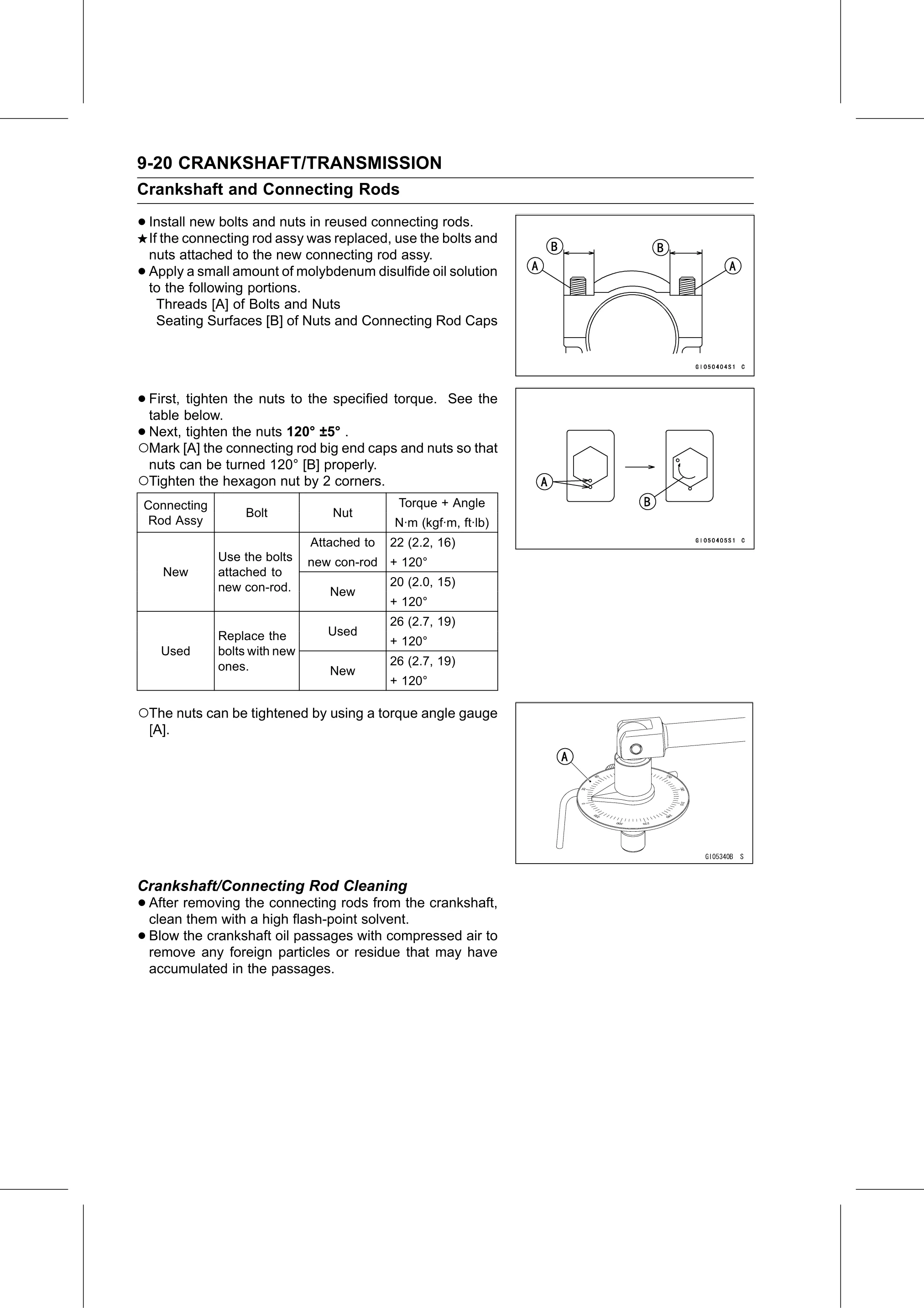
•   Apply a small amount of molybdenum disulfide oil solution
    to the following portions.
     Threads [A] of Bolts and Nuts
     Seating Surfaces [B] of Nuts and Connecting Rod Caps

• First, tighten the nuts to the specified torque. See the
  table below.
•○Next,  tighten the nuts 120° ±5° .
  Mark [A] the connecting rod big end caps and nuts so that
 nuts can be turned 120° [B] properly.
○Tighten the hexagon nut by 2 corners.
 Connecting                                    Torque + Angle
                    Bolt           Nut
  Rod Assy                                    N·m (kgf·m, ft·lb)
                                Attached to   22 (2.2, 16)
               Use the bolts    new con-rod + 120°
      New      attached to
               new con-rod.                   20 (2.0, 15)
                                   New
                                              + 120°
                                              26 (2.7, 19)
               Replace the         Used
                                              + 120°
      Used     bolts with new
               ones.                          26 (2.7, 19)
                                   New
                                              + 120°

○The nuts can be tightened by using a torque angle gauge
    [A].

Crankshaft/Connecting Rod Cleaning
• After removing the connecting rods from the crankshaft,
  clean them with a high flash-point solvent.
• Blow  the crankshaft oil passages with compressed air to
  remove any foreign particles or residue that may have
    accumulated in the passages.