Service Manual — page 606 of 715
Electrical System › Spark Plug Condition Inspection
Text on this page
16-46 ELECTRICAL SYSTEM
Ignition System

                           WARNING
    To avoid extremely high voltage shocks, do not
    touch the spark plugs or tester connections.

• Turn  the engine stop switch to run position.
• Turn  the ignition switch on.
• with the the
  Pushing       starter button, turn the engine 4 ∼ 5 seconds
            transmission in neutral to measure the primary
    peak voltage.
•   Repeat the measurements 5 times for one stick coil.
    Stick Coil Primary Peak Voltage
      Standard:     100 V or more

• Repeat   the test for the other stick coil.
  If the reading is less than the specified value, check the
    following.
     Stick Coils (see Stick Coil Inspection)
     Crankshaft Sensor (see Crankshaft Sensor Inspection)
     ECU (see ECU Power Supply Inspection in the Fuel Sys-
     tem (DFI) chapter)
Spark Plug Removal
• Refer to the Spark Plug Replacement in the Periodic
  Maintenance chapter.
Spark Plug Installation
• Refer to the Spark Plug Replacement in the Periodic
  Maintenance chapter.
Spark Plug Condition Inspection
• Remove    the spark plugs (see Spark Plug Replacement in
  the Periodic Maintenance chapter).
• Visually inspect the spark plugs.
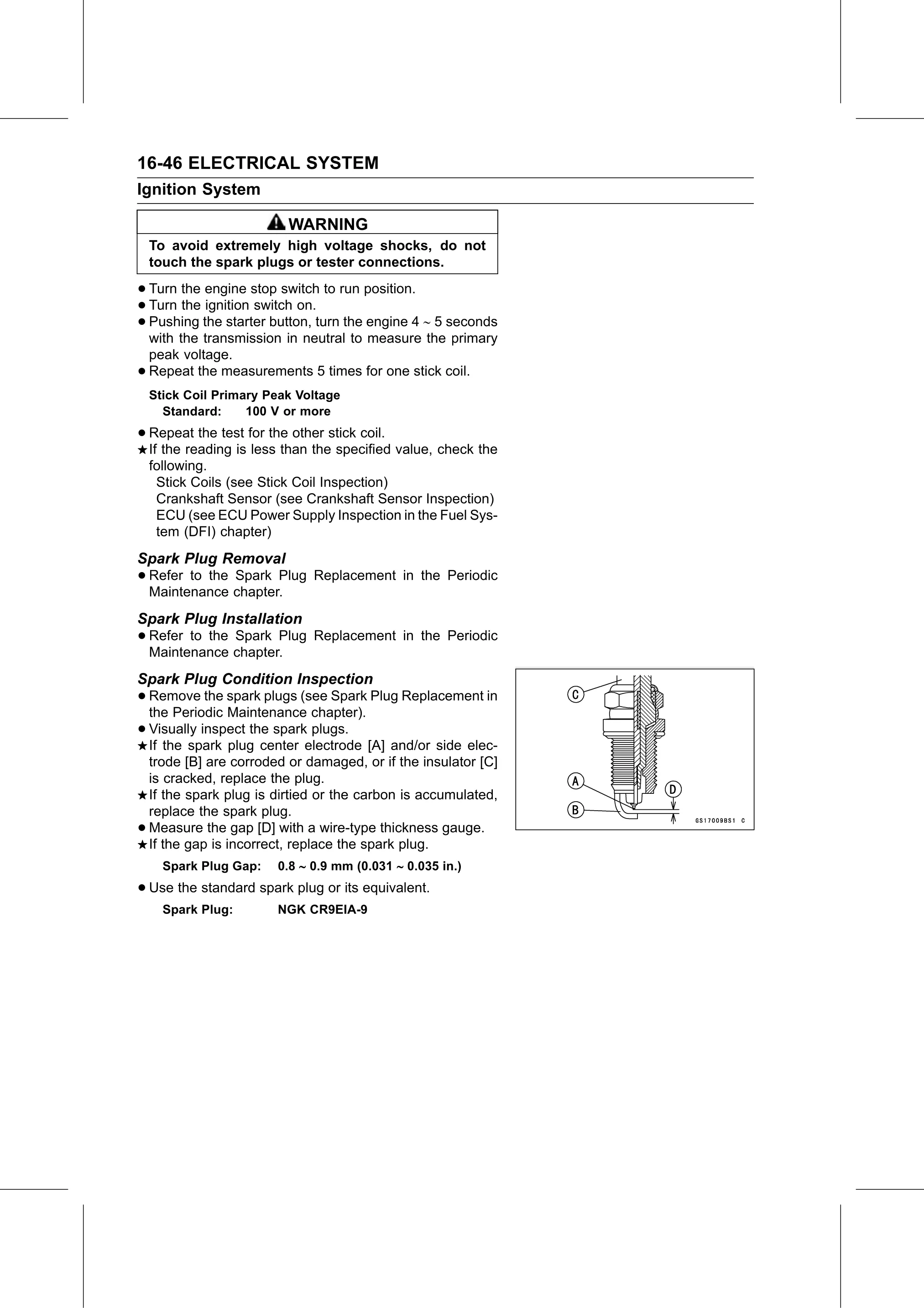
  If the spark plug center electrode [A] and/or side elec-
    trode [B] are corroded or damaged, or if the insulator [C]
    is cracked, replace the plug.
    If the spark plug is dirtied or the carbon is accumulated,
    replace the spark plug.
•   Measure the gap [D] with a wire-type thickness gauge.
    If the gap is incorrect, replace the spark plug.
      Spark Plug Gap:    0.8 ∼ 0.9 mm (0.031 ∼ 0.035 in.)

• Use the standard spark plug or its equivalent.
      Spark Plug:        NGK CR9EIA-9